

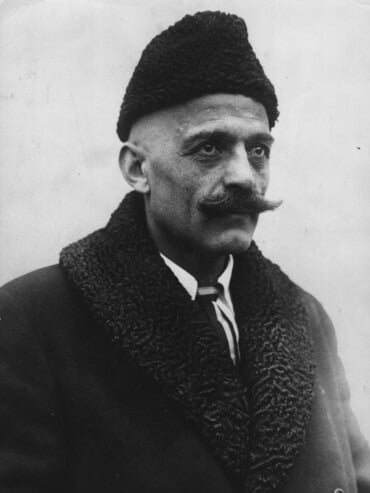
The name Sly Man Surf Club is a nod to the teachings of G.I. Gurdjieff and his ” Fourth Way” concept, also known as “the way of the sly man”, a system of thought focused on elevating the human soul and escaping the mechanization of everyday hypnosis. It is a practice characterized by a disciplined devotion to working on one’s self and an infallible dedication to one’s highest personal aim. In contrast to the conventional “surf shop” that emphasizes the hobbyist and leisure approach to surfing, Sly Man Surf Club will represent a brand, a club, and a shop that inspires respect and dedication to the art of surfing.
The first way is the way of the Fakir. It is a long, difficult, and uncertain way. A fakir works on the physical body, on conquering physical pain. The second way is the way of the Monk. This way is shorter, more sure, and more definite. It requires certain conditions, but above all, it requires faith, for if there is no faith a man cannot be a true monk. The third way is the way of the Yogi, the way of knowledge and consciousness. When we speak about the three ways we speak about principles. In actual life, they are seldom met with a pure form, for they are mostly mixed. But if you know the principle, when you study school practices you can separate which practice belongs to which way. When we speak of yogis we really take only Jnana‐Yoga and Raja‐Yoga. Jnana‐Yoga is the yoga of knowledge, of a new way of thinking. It teaches us to think in different categories, not in the categories of space and time and causality. And Raja‐Yoga is working on being, on consciousness.
The Fourth Way is sometimes called the way of the ‘sly man’. The sly man knows about the three traditional ways, but he also knows more than they do. Suppose people in all the ways work to get into a certain state necessary for some particular work they have to do. The sly man will produce this state in the shortest time of all, but he must know how to do it, he must know the secret.
The chief idea of this system was that we do not use even a small part of our powers and our forces. We have in us, so to speak, a very big and very fine organization, only we do not know how to use it. In this group, they employed certain oriental metaphors, and they told me that we have in us a large house full of beautiful furniture, with a library and many other rooms, but we live in the basement and the kitchen and cannot get out of them. If people tell us about what this house has upstairs we do not believe them, or we laugh at them, or we call it superstition or fairy tales or fables.”
It must be difficult; all work is difficult. Nothing is easy at work, but you can get something because it is difficult. If it were easy, you would get nothing
The two main visual references for the Sly Man Surf Club are Mori Yuzan’s Hamonshu: A Japanese Book of Wave and Ripple Designs (1903), a beautiful resource that sublimely renders waves in ink, and Tomoyuki Onuma’s Old-Style Alphabet Lettering of Japan, a collection of typography and branding from early post-war Japan. As with many things Japanese, these books treat visuals with a precision and fluidity unmatched, and echo bamboo-like strength and flexibility of Gurdjieff’s path of the sly man.
Sly Man’s typographical identity consists of two distinct approaches, one expressive and one clear and legible. For the expressive aspect several typefaces have been digitized from books on Eastern interpretations of the Western alphabet, like Gurdjieff, and like the truth, the most stable and honest path often cleaves the two polarities. The clear and concise path is represented by BPrever, a modern typeface that touches upon a groovy, hippie, aspect that is absent in the majority of the identity, but deserves a cameo.
The flag, the axis mundi, represents the centralized aim of both the shop and the individual. The storefront will be adorned with a flag, and the surfer will plant the flag on the shore. Some flags will don the quotations of Gurdjieff while others will simply display “Sly Man Surf Club.” The merch will be the main vehicle for logo experimentation, while the boards will bear a single consistent logo, to increase immediate recognizability, in time which logo should be used for the board will naturally reveal itself.